
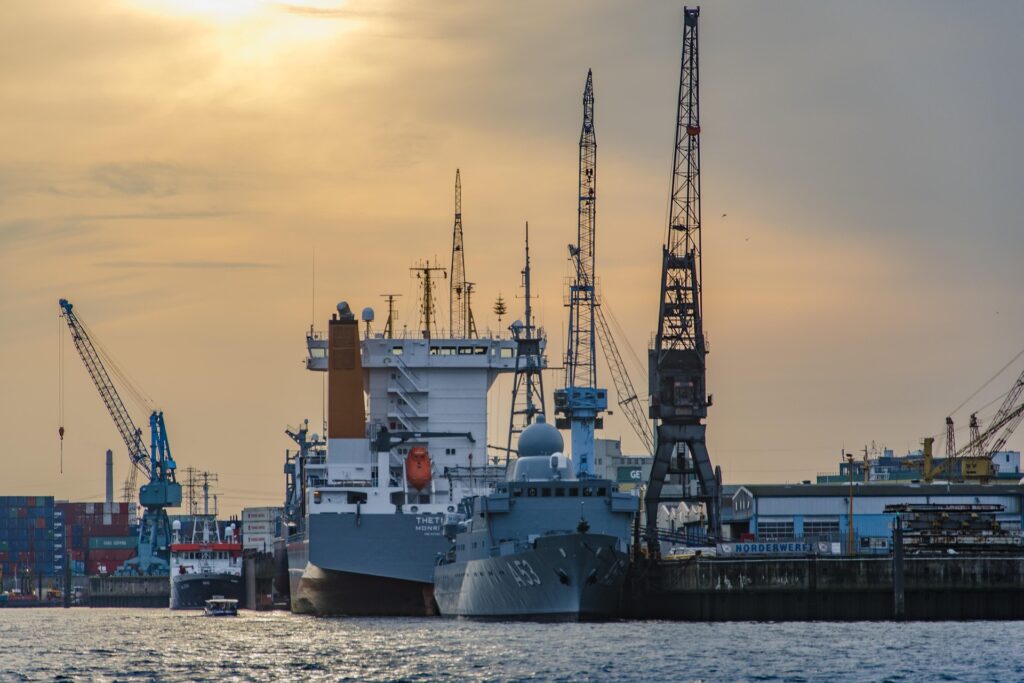
The potential blockade of the Strait of Hormuz has become one of the greatest geopolitical risks to international trade in 2026.
This maritime corridor connects the Persian Gulf with the Gulf of Oman and is a key route for the transit of oil, natural gas, and containerized cargo bound for Asia, Europe, and the Americas.
If this strategic route were restricted, the impact on international maritime transportation would be immediate and global.
How Would a Blockade of the Strait of Hormuz Affect International Transportation?
The stability of global trade depends on strategic corridors. One of the most sensitive today is the Strait of Hormuz, a critical chokepoint connecting the Persian Gulf with the Gulf of Oman and the Arabian Sea.
In a context of geopolitical tensions in the Middle East, a key question arises for importers and exporters:
What would happen to international transportation if this route were restricted or blocked?
A Critical Corridor for Global Trade The Strait of Hormuz is one of the world’s most strategic maritime routes. Due to its significance:
- Approximately 20% of global oil trade
- Liquefied natural gas (LNG) flows to Asia and Europe
- Containerized cargo from the United Arab Emirates, Qatar, Kuwait, and Saudi Arabia
- Key logistics flows connecting Asia, Europe, and the Americas
Any disruption, even a partial one, would have immediate effects on freight rates, transit times, and capacity availability.
Main Impacts on Maritime Transportation
- Increase in Freight Rates and Surcharges
In high-risk scenarios, shipping lines may apply:
- War Risk Surcharge
- Route diversion adjustments
- Increases in the Bunker Adjustment Factor (BAF)
The impact would not be limited to the Middle East. It could also extend to Asia–Europe and Asia–Americas routes due to fleet redeployment.
- Increase in Transit Times
If shipping lines modify their schedules or avoid port calls in the region:
- Rescheduling may occur
- Congestion at alternative ports may increase
- Service frequency may be reduced
This particularly affects supply chains operating with tight inventory levels.
- Fuel Price Volatility
A conflict in the region affects international oil prices.
As a result:
- Maritime transportation costs increase
- Air freight rates rise due to higher Jet Fuel costs
- Contractual adjustments may be applied to existing freight agreements
Impact on Air Transportation
Although maritime trade would be the most affected, air transportation could also experience:
- Route diversions due to restricted airspace
- Increased operating costs
- Greater pressure on freight rates due to increased demand for alternative transportation options
Global Domino Effect
It is important to understand that even companies that do not operate directly with the Middle East may still be affected.
When a strategic corridor is disrupted:
- Shipping lines redeploy capacity
- Alternative routes become more expensive
- Equipment availability becomes tighter
- Spot market volatility increases
International trade is an interconnected system. A regional disruption can quickly become a global phenomenon.
How Can Importers and Exporters Prepare?
In uncertain scenarios, anticipation is key. We recommend:
- Planning shipments in advance
- Evaluating alternative routes or multimodal transportation solutions
- Review of logistics contracts and insurance terms
- Implementation of safety stock for critical products
- Continuous monitoring of operational updates
Strategic flexibility becomes a competitive advantage.
Our Approach: Intelligent Logistics
The global environment requires informed decision-making and continuous risk analysis.
We continuously monitor geopolitical developments and their impact on routes, freight rates, and capacity availability in order to advise our clients proactively.
Rather than reacting to a crisis, the key is to anticipate it.
Because in international trade, it is not only about moving cargo.
It is about designing resilient strategies that protect business continuity.
Se trata de diseñar estrategias resilientes que protejan la continuidad del negocio.
References::
U.S. Energy Information Administration (EIA) – Analysis of the Strait of Hormuz as a critical corridor for global oil and natural gas trade.
International Energy Agency (IEA) – Oil market reports and projections on global energy supply and demand.
UNCTAD – Review of Maritime Transport y estadísticas del comercio marítimo internacional.
International Maritime Organization (IMO) – Reports on maritime safety and the stability of strategic shipping routes.
Lloyd’s List – Specialized coverage of geopolitical risks and war risk surcharges.